

Before coming to Spain to be a Language Assistant, I was a public high school teacher in a small town in Oklahoma. I loved working at my school in Oklahoma, as I made so many meaningful connections with students and fellow educators there, in addition to gaining valuable confidence and experience as an educator. However, the many demands on me as a teacher were difficult to keep up with. I had the same class schedule every day, with two preps, which meantI had to lesson plan for ten lessons every week. I also had my own classroom to keep clean and inviting, attendance to take each hour, morning and lunch duty to fulfill once a week, two grades to put in the gradebook every week, and absent work to prepare and provide for students who were absent for extracurriculars, illness, or appointments. I also worked mostly alone, creating my lessons by myself as a department of one.
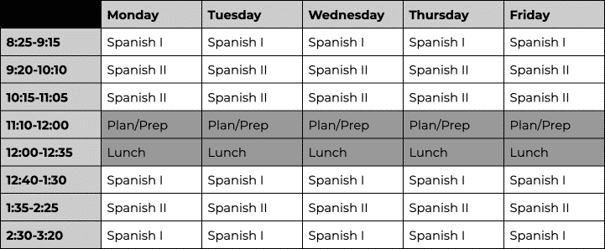
During my time as a Language Assistant so far, I have been surprised by how different the schedule and lesson planning are at my current school in Spain than at my school in Oklahoma. My class schedule is not the same every day; actually, every day I see different classes in a different order. At first, this was quite overwhelming, since I had expected myself to remember exactly where I needed to be at every hour of the day, and I felt guilty when I didn’t. However, a fellow Language Assistant grew up in the United Kingdom, where they have this same sort of schedule as in Spain. When I asked him how he knew what class he was going to, and how he didn’t get confused, he simply told me, “You just check your timetable.” He also told me that this schedule helps students stay more engaged, as they only have a class in each subject three times a week and at different times of the day. Once he explained this to me, I realized that I did not need to memorize my schedule and perfectly know exactly what I am doing at every minute of every day; I just needed to simply check my timetable and embrace the benefits of a more dynamic schedule.
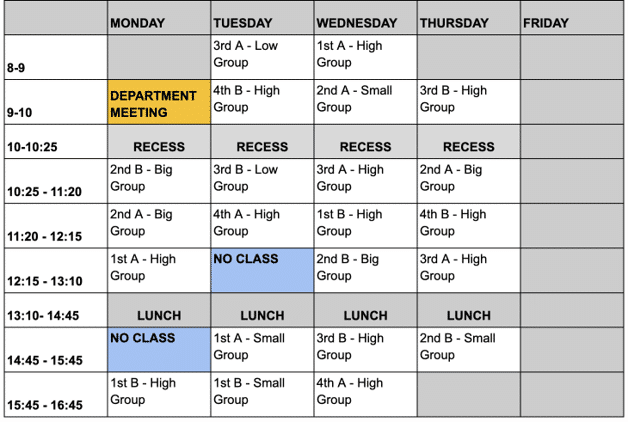
Additionally, in Oklahoma, I had each of my classes once a day, Monday through Friday, which meant I needed to prepare ten lessons a week in addition to preparing absent work if I knew students would be gone for an extracurricular activity. However, this looks different as a Language Assistant in Spain, as I only see each of my classes once a week, and they are not absent for extracurriculars—only illness, appointments, or class trips. My lesson planning takes much less time as I only prepare four lessons a week, and I do not have to prepare absent work. My students also do a lot of projects, which build teamwork, problem-solving, and time-management skills while requiring less prep as a teacher.
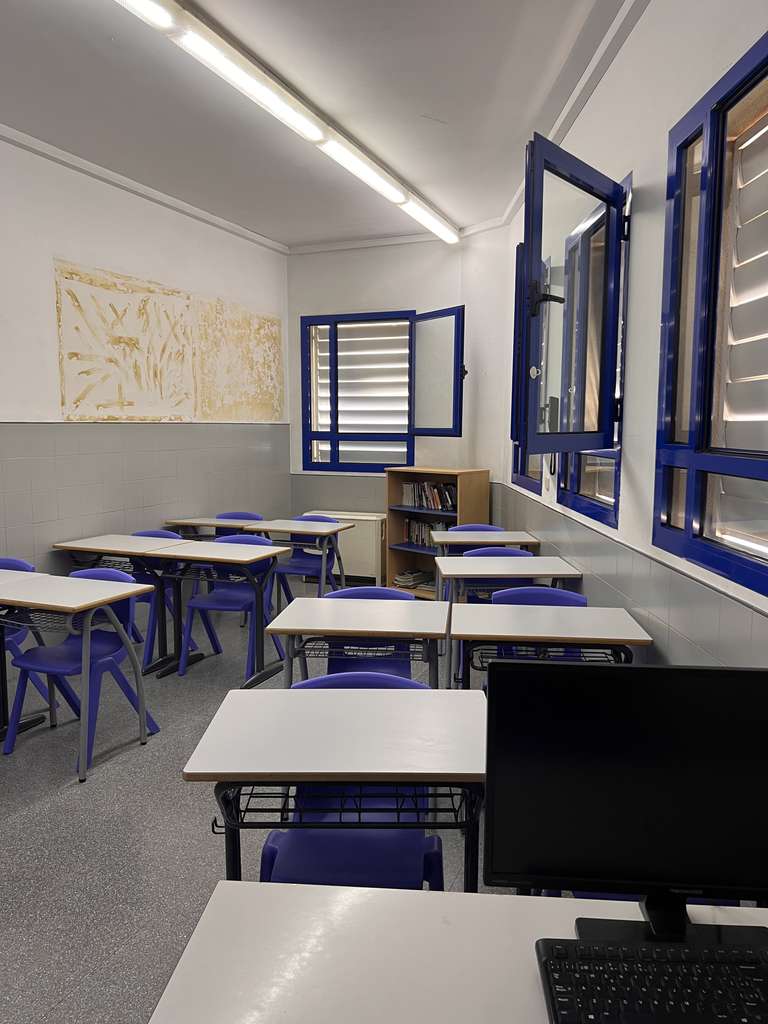
Another significant difference between teaching in Oklahoma and being a Language Assistant in Spain is that in Oklahoma, I had my own classroom, as did all of the teachers at my school. This is quite common in the United States, as students are expected to move from classroom to classroom according to the bell schedule. However, in many other countries—like Spain—most schools have a classroom for each class of students, and the teachers move from classroom to classroom. Therefore, in Oklahoma, a grade of 60 students could, at any point of the day, be divided between many different classrooms, depending on each student’s schedule. At my school in Spain, a grade of 60 students is divided between two classrooms, and each of those classes shares a schedule. If the class does split, they split into smaller groups within the same subject.
Since teachers do not have their own classroom, we all plan, prep, and store materials in the teacher workroom. There are tables for teachers to work at, shelves to store their materials and belongings, and computers for printing materials. But the best part of the workroom is that here, teachers talk to each other, collaborating on what to do with their classes or how to help a student, or even just to share chocolate candies. The teachers at my school have been so kind and inviting, welcoming my ideas and sharing conversation and candies with me, even asking me if I feel better after I was out sick for a day.
These differences—the school schedule, lesson planning expectations, and teacher workroom—have shown me that teaching can be simpler, more relaxed, and collaborative than the way I taught in Oklahoma. I am becoming more flexible, being able to pivot when a projector does not work or moving classrooms when the wifi is out. These sound simple, but in Oklahoma, I would have panicked if my plans had to change that much! As I reflect on my time teaching in Oklahoma and Spain, I am reminded of the joys of teaching—seeing a student really understand something, saying good morning and receiving a smile, noticing a group of teens laughing and making fond memories together. Those joys are the same whether you are a teacher in Oklahoma or a Language Assistant in Spain.
Author: Larin W.