

With lots and lots of games, of course! Here’s what I’ve made so far:
When students only learn a language in school, most of them only know English from the content in a textbook. My goal as a Language Assistant is to expand that view, to get students to speak English. Every language is a cumulation of all those who speak it, a rich culture, media, and history. Knowing English– or any language, for that matter– opens the door for students to experience all of that. For me, the first step to taking English learning beyond the textbook is through games.
In order to understand how I am able to do this, we need to dive into my role as a Language Assistant. At the school, I pull small groups of students and create level-relevant speaking activities to do with them. Because the majority of their work in class is textbook-based, and they are focused on learning grammar and conjugation, I am able to spend my time with them building on their knowledge by doing something fun. I choose to do this through games! For me, this method works really well because the students speak English with me on specific topics, but don’t feel like they are doing work. I also find that games tend to break the barrier of nervousness that most students have when speaking an unfamiliar language.
I like to create my own games based on famous ones; for instance, I’ve made a Guess Who game for landscapes instead of people, a Clue-style mystery game built around hidden sports terms, and much more! By far, my most successful game has been an Apples to Apples-style game with school-relevant situational prompts and questions. Each round, one student draws a prompt card– something like “Who would you most like to sit next to on the bus?”– and the others then secretly play one of their character cards. These are student archetypes such as The Class Clown, The Gamer, The Sports Fan, The TikToker, The Bookworm, or The Overachiever. Students then defend their answers: “‘The Foodie’ would give good snacks on the bus!” or “‘The Overachiever’ would help you with homework you missed before school.” In the process, students practice essential speaking skills such as expressing opinions, using comparative language, agreeing and disagreeing politely, and responding spontaneously to others.
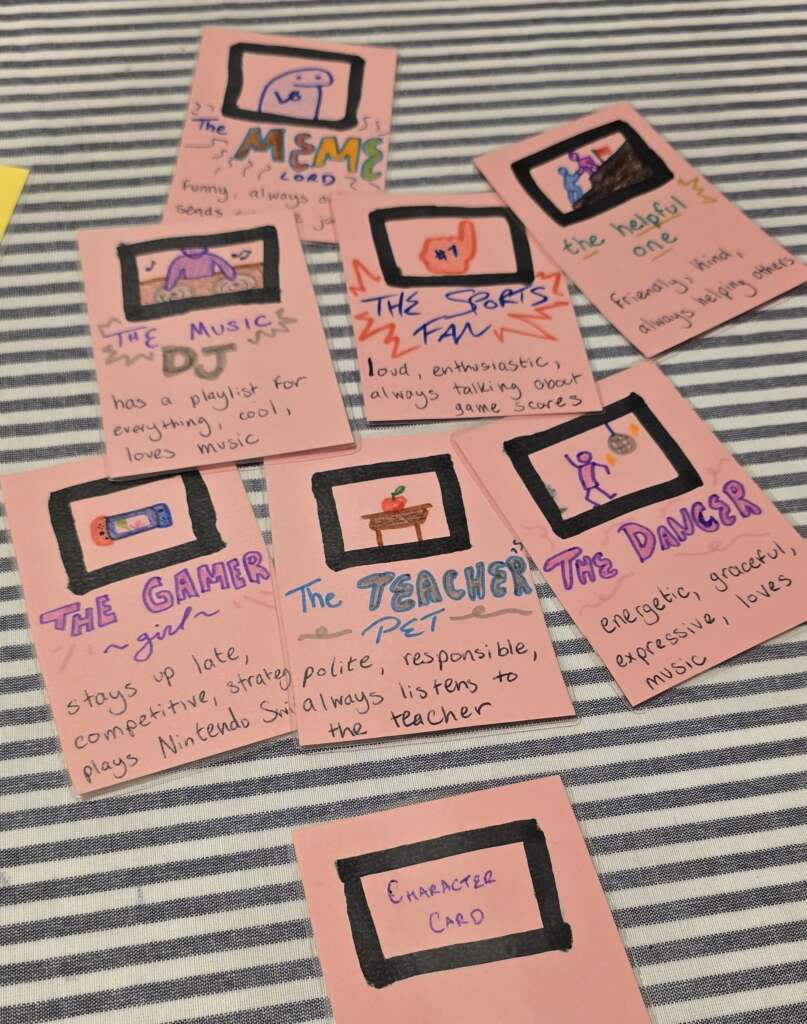
For me, these games help me cultivate a positive learning environment for small group activities. The students are excited and relaxed when they come to do speaking exercises, which is something often very nerve-wracking for them, and this puts them in a great position to apply themselves to learning. More importantly, English evolves beyond a school subject in their minds and becomes a tool for communication.
I spend a lot of my free time each week developing and then making these activities come to life, and I’m eager to continue with this creativity in the months to come. After all, as a Language Assistant, I have the freedom to help students see English as something living and shared. I want them to use language as a tool to connect them to the world beyond their classroom. Just as every language carries the stories of its speakers, every lesson we share adds a new layer to that story, and I hope the games we play can make it a positive one.
Author: Brianna A.